Arete
Arete is the queen of the Phaeacians, wife of King Alcinous, and the daughter of Rhexenor, who was himself the son of Nausithous and a descendant of Poseidon. She is honored beyond all other women by her children, by Alcinous himself, and by the entire Phaeacian people, who look upon her as a goddess and greet her whenever she walks through the city. Her wisdom and fairness are such that she helps settle disputes not only among women but also among men, and her good will is the key to any stranger's hope of returning home. When Odysseus first arrives in Scheria, it is Arete whom Athena instructs him to approach first, telling him that if he can gain her favor, he may hope to see his friends again and get safely back to his own country.
Lineage and Status
Arete's ancestry ties her directly to the ruling house of the Phaeacians and to the god Poseidon. Her father Rhexenor was killed by Apollo while still a bridegroom and without male issue, leaving Arete as his sole heir. Alcinous married her and, as Athena explains to Odysseus, he honors her as no other woman is honored among those who keep house with their husbands. This exceptional respect is not merely domestic: the people of Scheria look upon her as a goddess, and she exercises real authority in the city's affairs. When she walks through the town, she is greeted by all, and her judgment in disputes is sought and respected. Her position is thus unique among the mortal queens of the epic, combining royal lineage, divine favor, and practical political influence.
Role in Odysseus's Reception
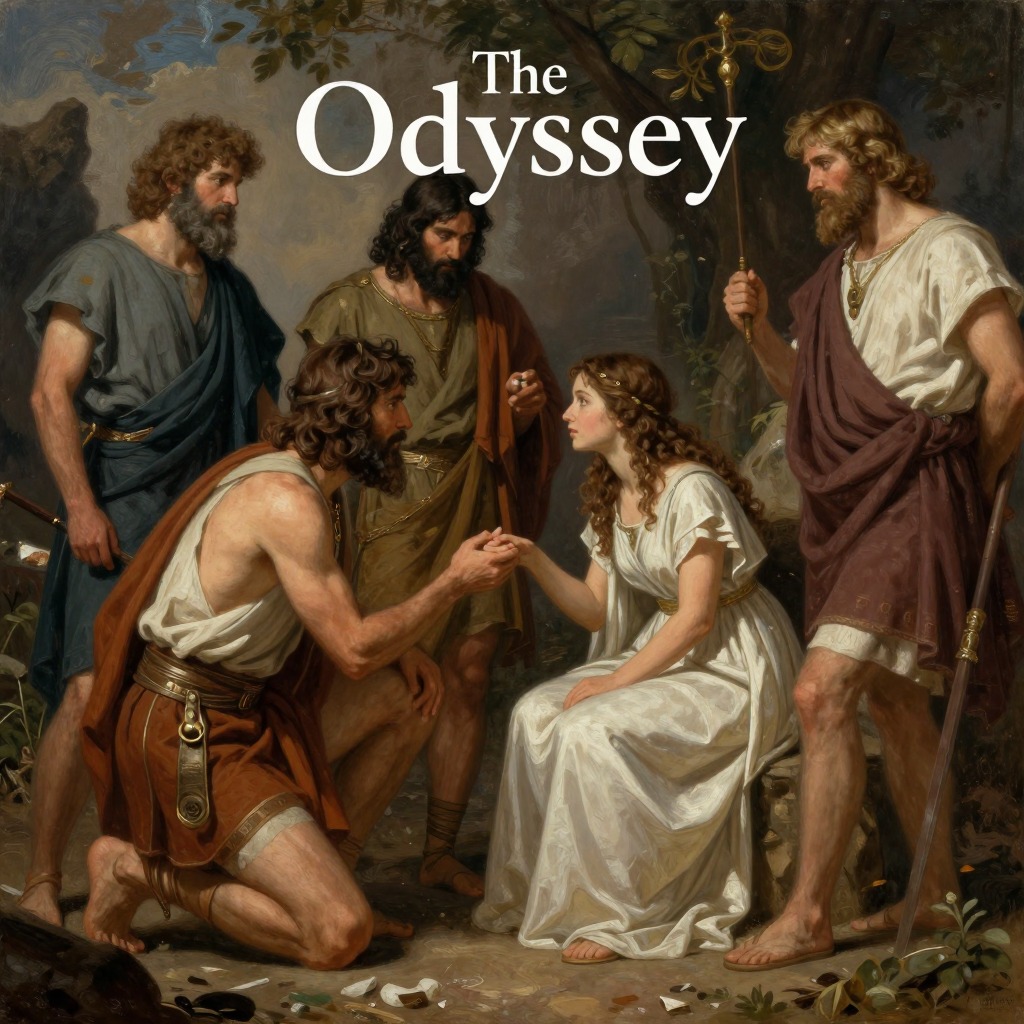
Arete is the first person Odysseus addresses when he appears before the Phaeacian court. Following Athena's instructions, he crosses the threshold of Alcinous's palace, still hidden by the mist of darkness, and lays his hands upon Arete's knees as a suppliant. The moment the darkness falls away, he speaks directly to her, begging her and her husband and their guests to help him return to his own country. It is Arete who first speaks after the feast, recognizing the clothes Odysseus wears as the work of herself and her maids, and demanding to know who he is and where he came from. Her question prompts Odysseus to tell the full story of his captivity with Calypso, his shipwreck, and his rescue by Nausicaa. Later, after Odysseus has finished his long tale of wanderings, it is Arete who addresses the Phaeacian lords, urging them not to be hasty in sending him away nor niggardly in their gifts, for heaven has blessed them with abundance. Her words carry such weight that the aged hero Echeneus immediately seconds them, and Alcinous confirms that the decision rests ultimately with him but that Arete's counsel is both reasonable and to the purpose.
Authority in the Household
Arete's authority extends to the practical arrangements of hospitality. When Alcinous declares that Odysseus should be given a chest of gifts, it is Arete who brings the magnificent chest from her own room, packs the presents of gold and raiment inside it, and adds a cloak and a good shirt from Alcinous himself. She then instructs Odysseus to see to the lid himself and have the whole bound round at once, for fear anyone should rob him while he sleeps on the ship. This attention to detail and her direct involvement in the packing show that she is not merely a figurehead but the active manager of the household's treasures and the guarantor of the guest's safe departure. When Odysseus finally takes his leave, he places the double cup in Arete's hands and bids her farewell, wishing her happiness in her house with her children, her people, and with King Alcinous. This gesture, performed in front of the assembled Phaeacians, publicly acknowledges her as the co-equal center of the royal authority.
Thematic Significance
Arete represents the ideal of the wise and powerful queen in the Homeric world, a figure whose influence is both domestic and political. Her name itself means "virtue" or "excellence," and she embodies the qualities that the poem prizes in a ruler: wisdom, fairness, hospitality, and the ability to command respect through character rather than force. In a narrative where the proper exercise of authority—whether by kings, queens, or household servants—is a central concern, Arete stands as a model of how power can be wielded with grace and effectiveness. Her role in securing Odysseus's return also underscores the importance of female agency in the epic: it is not only the male heroes and gods who determine the outcome, but also the quiet, authoritative intervention of a queen who knows when to speak and when to act.